parenting, the garden project

Gardening and parenting: a note to self

If I intervene with horrified shrieking when Leon plays with dirt and hoicks things up now, he is less likely to be positive about the garden later on, at an age when he can learn the difference between ‘weed’ and ‘not-weed’. It is therefore worth sitting on my hands as dirt and plants go everywhere. (The volunteer broccoli raab from the satsuma tree pot may survive; the rocket certainly won’t but there is plenty of rocket.)

Leon pulling a handful of dirt from a large pot
Scattering dirt is fun!

A corollary: any potentially vulnerable plants that I really seriously care about are going to need some form of defence. I’m thinking in particular of my carefully-nursed autumn olive seedling, the sole survivor from a handful of seeds I stratified last winter and planted out in the spring, currently overwintering on the windowsill.

It was a lovely afternoon to be out in the garden, though. I planted peas by the fence, and Leon ate moss and dirt and threw soil around by the handful. Happy times.

permaculture, the garden project

Back garden fruit

Having rearranged the herb garden, I looked at the vast expanse of 6+ foot high, south-west facing fence behind it, and thought “Something should be growing across that. Specifically, a productive climber that produces something tasty…”. So last week I planted a dessert grape vine (Lakemont Golden Seedless Dessert, more info here), which I’m hugely excited about. It’s supposed to do well in this climate if in a sunny spot, so I have high hopes – and grapes are one of my favourite fruits. I need to get some organic tomato fertiliser and apply regularly this season, and read up on pruning next winter. Grapes grow on last year’s vines so nothing will set this year. Lakemont are heavy cropping, self fertile, suitable for outdoor growing, and very sweet, and harvest in London should be late September.


Grape vine hacked back to recommended three buds

Over the other side of the garden, no sign yet of this year’s autumn raspberry canes. My thumbs are crossed that they’ll spring up soon from the canes I brought in from the allotment last summer. If not, I may have to buy some more next winter.

I’ve also been thinking about the farthest end of the garden, where the compost heap and shed are, and where there is a little less sun due to the back fence. There were three major issues on my mind:

  • The compost heap, while a glorious thing in many ways, is not wildly attractive when viewed from the back door.
  • There is a couple of metres at that end of the garden that is currently still paved and underused (occupied, as it was at the time, by paving slab piles).
  • Small gardens benefit from having things to break the line of sight up. Dividing the garden up a little can make it seem bigger.

A bush of some sort in front of the compost heap, just at the limit of the shaded area, seemed the perfect solution. And since I wanted something productive, a blackcurrant bush (Ben Sarek Organic, a small-middling bush which fruits mid-to-late season) was the obvious choice. So I’ve taken up another two paving slabs and planted a tiny stick of a blackcurrant bush there. Hopefully it too will thrive. I’m a little concerned about how much sun it will get; I think it should be just about enough (the tomatoes against the fence there did fine last year) but we shall see.


I always find it difficult to imagine that a twig like this one, barely visible beside its stake, will ever grow into a big fruit bush, but hopefully…


This was previously occupied by a big pile of paving slabs. Clearly I now need to work out what else to do with it. Possibly a bean tipi this year?

One final note: I planted the grape vine in the corner of the oldest of our raised beds, put in 20 months ago when we first moved in. At that point, the soil underneath when we pulled the paving slabs up was heavy, compacted clay, which I shoved a fork into a few times before dumping compost on top. Now, I could dig right down into it with a hand trowel with no trouble, and it’s full of worms and soil life. That’s just from adding compost and green matter on top, and planting in it. An incredibly pleasing change to see!

growing things, the garden project

Replanning the herb garden

I took advantage of a brief sunny period mid-week to go out and rearrange the herb patch.

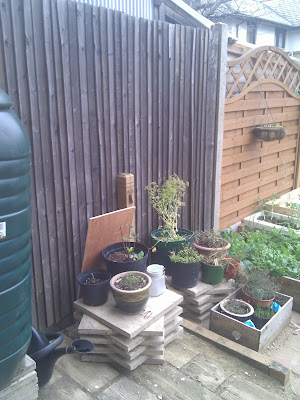
Sadly I don’t have a very good before photo, but this one from this time last year is a reasonable representation:

Herbs in pots against a fence

This is what it looks like now:

Herbs in pots, in different configuration (see text)

Left to right: strawberry tower (transplanted the strawberries this morning); slab stack with empty pot (for basil), oregano, 2 lavender cuttings, empty pot, another lower empty pot, & a big pot of sage; bay tree at the back; another slab stack with parsley, chives, empty pot, and mint lower down; and a thyme trough at the front.

I moved the concrete slabs very slightly so they’re right back against the fence, and reorientated a couple of lower ones to provide an extra ledge for a plant pot, to make more use of the vertical space. I also repotted the oregano and bay into bigger pots, and the thyme into a shallow trough. I’ve since added a few more empty pots, for a total of 9.

My wanted herb list is:

  • Basil (lots)
  • Oregano (lots — will take a couple of root divisions now it’s in that larger pot, although this is not the ideal time for that)
  • Thyme (want another couple of plants)
  • Sage (will take cutting in the spring to fill up that big pot)
  • Chives
  • Winter savoury
  • Mint — will probably take cuttings for another pot to go at the other side of the patio, as well
  • Parsley (lots, which is fine as it has self-seeded EVERYWHERE)
  • Coriander
  • Dill
  • Strawberries (OK, not actually a herb)
  • Bay
  • Rosemary — over the other side of the garden, in the ground
  • Lavender — also planted on the other side, in the ground

With nine empty pots to fill, I make that: basil x 2, another oregano, possibly another parsley, dill x 1, winter savoury x 2 (it’s hard to buy), coriander x 1, and one spare pot in case something else takes my fancy. I’m tempted to try ginger, although it’s not cold-hardy. Any other culinary herbs you think I’m missing out on?

growing things, the garden project

Shallow growing

In the course of planning both back & front gardens, I need a list of things that will grow in shallow (6-9″) containers, as I have quite a lot of them. Herewith the results of my research thus far.

Greens:

  • Rocket
  • Lettuce generally
  • Mustard greens?
  • Peas – not 6″, apparently ok in 9″
  • Beans – not 6″, apparently ok in 9″

Other veg:

  • Tomatoes – not 6″, apparently ok in 9″
  • Carrots – not 6″, apparently ok in 9″

Fruit:

  • Strawberries

Flowers:

  • Marigolds
  • Nasturtiums
  • Pansies
  • Poppies

And some things which in my experience don’t do so well:

  • Chard (probably because it’s secretly a root).
  • Parsnips, roots generally.

I’ve had trouble with peas and beans in containers before, but it’s possible they were a bit shy of 9″, so I’ll give it another try. Unfortunately I think the majority of my containers are less than 9″ deep so planting is going to be a bit restricted. My inclination is to plant in the ground in the back garden wherever at all possible (perhaps taking a few more paving slabs up), and to keep the containers for the front balcony and porch). I will return to this at the end of the season with my findings.

Any other suggestions? I haven’t got anything particularly out of the ordinary here, nor indeed anything perennial except the pansies. I’m considering looking into the Plants for a Future database or something similar. On the other hand, time is getting on so I might just try some annuals out for this year.

growing things

New year, new growth

I don’t really do resolutions per se (this post by Meg Barker is excellent on the matter). But if you looked out, on a bright, sunny New Year morning, at your patio (or balcony, or windowbox…) and thought about growing food in it, you needn’t put the whole thing off til spring. Sure, it’s not the time of year (in the Northern hemisphere) for doing much planting, but there are still things you can get started on now.

First up is planning. If it gets to March or April and you haven’t given any thought to what you’d like to grow, that’s fine (it’s better to throw a few random seeds in than to do nothing), but even a little thought in advance can make your space much more productive. What veggies do you most like? No point in growing things you won’t actually eat. How much space have you got? Do you need to find some containers? Can you order seeds now? The Real Seed Company are good for seeds (and browsing their website may give you ideas), and nearly anything you can put some drainage holes in the bottom of can become a planting container.

This is also a good time for planting fruit. Blackberry, raspberry, blueberry, blackcurrant, and the rest will all grow happily in pots. Blueberry in particular may be better off in a pot, as it is ericaceous (lime-hating) and needs specific compost or acidic soil. (If you already have a blueberry, in fact, now is a good time to pH test the soil, and add compost, or water with 1-2 tbsp of vinegar in a gallon of water, if needed.) You can buy bare-root plants and get them in the ground over winter, though you’re unlikely to get a crop until summer 2014. I confess I’ve never personally managed to make blackberries or raspberries work in pots, but I am assured that it is possible. Perhaps I needed a bigger pot.

You could also consider a fruit tree (an apple, perhaps), if you have space and ground. Fruit trees too can be grown in (large) pots; I have a satsuma tree in a pot, but it’s not doing so well. Down at Downing Road Moorings, near me, they have a lot more success with trees in containers (of sorts). If you already have fruit trees or bushes, now is a good time to prune. You usually want to lose about 15% of old growth each winter.

Finally, it’s never too cold and dark to try planting a tray of microgreens. Get sme rocket or any other green-leaf seed (mizuna is nice), plant it in a shallow tray on the windowsill, and wait until the second set of leaves (the first set of “real” leaves) appear. Harvest with scissors and eat.

See my book for more detail on any of the above, and ideas for getting going with permaculture container gardening whatever time of year it is. And watch this space for an update on my own plans for my garden this season; I’m planning to sit down with a notebook this weekend.

growing things

Tidying up the garden for the winter

At the weekend I hoicked out the tomatoes (getting a fair crop of green tomatoes in the process), courgettes, gone-to-seed lettuce, and a bundle of unexpected carrots, to clear some space before winter.

I also dug over the compost and found huge bundles of happy worms and woodlice doing their thing in there. (I should really have taken a photo, shouldn’t I?) I felt a bit bad upsetting them all in order to extract some of the lovely dark compost-y compost from the bottom of the pile. There was enough to spread over a single bed; hopefully by the spring there’ll be another bed’s worth as well. There’s something very satisfying about compost; all that waste turned into lovely rich stuff to help your plants grow. It just looks productive.

Winter lettuce is doing nicely and needs thinning soon; chard also doing well; pak choi suffering from slug/snail depradations.

I also planted one whole bed and an extra row of broad beans, and two rows of snow peas. By getting the beans in now, they have a chance to get going in the spring before the ants and the aphids move in. Which also means that after the first crop in the spring, I may as well hoick them out again as by then the ants and aphids have overrun the plants. That, in turn, means I can plant nearly as many as I like since by the time I want to put other things in, they’ll be out. Succession sowing is also very satisfying!

food, growing things

Adventures in Parenting: food from the garden

It’s taken a looong time this year (possibly because of June’s dreadful weather), but finally I am regularly harvesting food from the garden*. Carrots (my first ever really decent carrot crop!), courgettes, little cherry tomatoes, chard, and the last of the garlic.

Simultaneously, L has started on solids, which is great fun. We’re doing baby-led weaning, so I’ve been putting slightly more effort into lunch (ie not just hummous sandwiches) then just giving L some of whatever I fancy eating. If possible, including at least a little of our back garden veg. Stir-fried chard, courgette, carrot, and a little garlic, with rice or rice noodles; a few halved cherry tomatoes or some rocket on the side; pasta with garden veggies in a tomato-y sauce; steamed veg with a baked potato.

L is a big fan of courgettes and carrots (most of it eventually ends up on the floor, and thence in the dog, but he grabs and sucks and gums with enthusiasm). The first time I gave him a cherry tomato, he pulled the most peculiar face and drummed his feet on the high chair, and I assumed he must not like it. But no; when it fell out and I put it back on the table, he grabbed with enthusiasm and shoved it straight back in, for another flapping-and-grimacing session. I guess tomatoes must be pretty intense (and home-grown fresh tomatoes even more so) after six months of breastmilk.

Seeing him starting to experiment with food has been fun; being able to share food that I grew with him has been fantastic.

It’s not that I want to be parenty-high-horse about it. L is also eating plenty of stuff I didn’t grow; and I don’t garden because I think it’s better for L, although I do want to reduce household food miles**, but because I love doing it. It’s one of the non-parent things I’ve tried to keep up while submerged in newborn parenting.

But I love growing food, and I love eating food I’ve grown, and I love being able to include L in that. Some of those plants I planted (or watered, or thinned) while carrying him in a sling over the last six months. I harvest them while he plays on the grass, and then we both eat them. It feels like the way I want my life to fit together, with the various parts of it feeding (ha!) into one another.

And then I blog about it, and the words join into the same pattern.

* There’s been salad all summer; but we haven’t eaten that much of it. I have to conclude that we just don’t eat much in the way of salad leaves, even nice ones, and intend to plant much less of that next year.
** Not that our tiny back garden meets more than a fraction of our food needs, although I’m trying to improve on that over time as I work out what’s best to grow.

growing things, the garden project

Garden Diary 25.08.2012

Planted:

  • Basil.
  • Leaf coriander.

Harvested:

  • Courgettes.
  • Very tiny baby carrots.
  • Salad leaves.

Other:

  • Discovered that three of my blackcurrant bush cuttings may have taken!
  • Snails ate many of the chard seedlings; but it looks like one or two have survived.
  • Ordered some autumn/winter seeds.

To do:

  • Thin out lettuce some more.
  • Dig/set in border of long west bed properly.
  • Transplant courgette plants which I think are overcrowded.