the garden project

Poly-veg winter bed: update

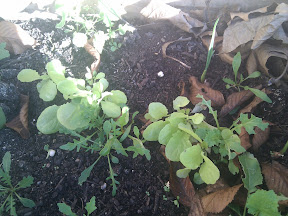
With the single currently-active raised bed in the back garden, I experimented with a winter polyculture, or mixed-veg bed. It’s now looking very healthy, with plants in various stages of growth:

  • Some garlic poking its head up, all around the edge of the bed. Garlic is often a good choice for edging beds, as it’ll help to keep off pests (when they return in the spring). I didn’t get around to getting a decent bulb of garlic from a proper shop, so I just stuck in cloves from a bulb from the Co-op. I wouldn’t want to save any cloves for next year from this crop (since I know nothing about its parentage), but it was a quick and easy solution.

    Garlic shoots, with other greens around them
  • A row of winter lettuce seedlings at the back of the bed.

    Row of small light green winter lettuce seedlings, with some dark green rocket seedlings
  • Some very healthy-looking broccoli raab and turnips (although the turnips themselves are not up to that much; I will use the greens as well when I pull them up, to make the most of the crop).

    Thickly-sown broccoli raab and turnip plants, looking quite intertwined with each other
  • A couple of small chard plants.

    Three small chard plants, surrounded by other greens
  • You may also spot a fair few small rocket plants scattered around the bed. I had lots of rocket seed so scattered it widely. It needs some fairly aggressive thinning, as it’s over-thick, but it’s very tasty so this isn’t a hardship. Having the soil covered thickly like this with plants I do want reduces the number of plants I don’t want (weeds) which can make their way in.

In addition to that lot, there’s a few snow peas and broad beans that aren’t quite up yet, planted where there were some bare patches towards the back of the bed. Looking for bare patches as the crops start to come up, and taking advantage of them, is another principle of polycultures and forest gardening type approaches.

I’ve also constructed another couple of raised beds (one has some broad beans in, but neither are full of compost yet), and transplanted the rosemary to its new home against the fence. The soil here is not great for a Mediterranean herb like rosemary; it’s very clay-heavy, and not well-drained. To give the plant the best chance, we dug a biggish hole and dug in some compost and sharp sand at the bottom of it and around the plant. It’s a sturdy plant (and was badly outgrowing its pot), so hopefully it’ll survive the winter and get going again in the spring. The cuttings that I took (in case it does turn up its roots and die) seem to be doing well so far.

For the end of November, it’s all looking pleasingly green; and I’m still getting regular (albeit small) crops of greens from it.

misc, permaculture

Online distraction

I spent a weekend recently at the Ecolodge in Lincolnshire, an off-grid cottage in a couple of acres of meadow and woodland. Doop, the Sidney-dog, and I spent a very lovely four days reading, chatting, doing a jigsaw puzzle, snoozing, and walking around the grounds.

It gave rise to some thoughts around distractions and my ability to get things done. There’s no mains electricity at the Ecolodge, so no wireless, no 3G (we turned our phones off on arrival)… No phone calls or texts. No email. No Internet at all.

I was suddenly very aware of my reflex to reach for the refresh button (on my RSS reader, on Twitter, on one of the forums I read) every time I have a moment where I’m not doing something else. Or, more importantly, a moment where I am doing, or trying to do, something else, but in some sense don’t want to be. Something I’m procrastinating on; something I’m scared of; something I’m finding challenging. The myriad distractions of the Glorious Internet are there to help me escape every time I have a difficult moment.

If that were satisfying in itself, perhaps it might be indicate not that I have a distraction problem, but that I need to check how many of the things on my to-do list are really important to me. But it’s not; after half an hour of reading blog posts I rarely feel satisfied, or better about anything much at all. It’s not that there isn’t some great writing out there; it’s about the way I approach that writing, not as a worthwhile thing in itself, but as an escape-route.

After two days of information-detox, I noticed myself feeling calmer, and less twitchy. I even got some writing done. Two days later, though, I could feel the stress levels rising again as I switched my phone back on.

I’ve tried “offline Sundays” before and enjoyed them, but stopped again for no readily apparent reason after a month or two. I’ve tried “two working days a week offline” before, too, and whilst I enjoyed that too, it lasted barely a the fortnight. This time, I broke my attempted resolution of a week off “recreational” browsing about two hours after I got in the front door.

I don’t want these distractions. I don’t want to be numbing my discomfort every time I sit down to tackle a complicated task. I want either to get on with doing that task, or to talk to the monsters a bit and find out why I’m uncomfortable) with it. On the other hand, nor do I want to lose my online reading habit altogether. It’s still true that there is plenty of good stuff out there, and there are friends I want to keep up with.

The problem is that I still don’t know how to manage those things. I’m choosing to see it as a good first step that I’m asking the question; that I’m catching myself when I reach for that refresh button, even if all I do is observe myself allowing the distraction to take over. It’s a start.

the garden project

Cargo bikes, fracking, and raspberries

I have been writing things in other places!

UK Activists Tell Energy Companies To Frack Off.

Kids and cargo bikes. (Since writing that, we’ve decided to go ahead and get the Christiania trike. I am inordinately excited, though we won’t be ordering it for a month or so.)

In ‘garden’ news, yesterday I transplanted 6 raspberry suckers (4 autumn raspberries, 2 summer raspberries) from the allotment to the western garden fence. I’m unsure how they’ll get on with the clay (I dug in a little sand and compost), but as otherwise the suckers would have been snipped up and put in the compost, it’s worth the experiment.

the garden project

Self-fertile apple trees for small gardens

I’m keen to have a fruit tree in our garden, and my mind turned to what’s really the default UK fruit tree: the apple. The thing with apple trees, though (and in fact many fruit trees), is that if you want to get actual fruit, the tree needs to be fertilised. For the vast majority of apple varieties, that means having at least one other apple tree, of the right pollen group and which blossoms at the right time, planted somewhere fairly nearby. In an orchard, a big garden, or even in an allotment where you can count on other allotmenters also having apple trees, that’s fine. If, on the other hand, you have a tiny garden like mine, one tree is going to be pretty much all you can fit in.

Happily, in this modern age, you can get self-fertile apple trees; that is, trees which will pollinate themselves. Even so, they’ll do better (crop more heavily) if pollinated by another nearby tree, but you’ll get a crop anyway. For my purposes, all I want is a few eating apples, and a tree to sit under, so that’ll work fine for me.

The choice, though, is a bit limited — here’s one list*, although note that some of those (the starred ones) are only partly self-fertile, so best to avoid if you don’t want to rely on having another tree in the vicinity. In my case, it’s limited further by the fact that the apples best-liked in our household are the Cox/Russet kind of axis. I couldn’t find any self-fertile russet types, but here is my list of self-fertile Cox-types:

For me, I think it’s a toss-up between Red Windsor and Winston, with a probable bias towards Winston. I shall consult the rest of the household.

A quick note as well on rootstocks. M27 will give you a very small tree (up to 2m), but unless you’re seriously space-limited or growing in a pot, you’re probably better going for M9 (full height up to 2.5m), which is a little bigger and significantly more productive. Both M9 and M27 require permanent staking. If you have the space, M26 is bigger still, and MM106 a decent standard size, growing to 2.5-4.5m. For my 40m2 garden, I’ll be choosing M9 as a good compromise between size and productivity.

* I have noticed some disagreement between different lists on whether or not particular apples are self-fertile. I recommend cross-checking a couple of sources before buying.

Uncategorised

Building a table

I went to a workshop on Wednesday at the OffMarket Freeschool (running for another week yet, with some great workshops still to come!) on furniture building. It was very much about using what you have around: we started out with some thick plywood, a table top, and some lengths of 2×2, and we fetched up with a pretty solid table.

(I also discovered the wonders of a handheld circular saw. Awesomeness.)

The basic principle goes like this:

  • Work out how long you want the table’s legs to be, and cut 4 lengths of 2×2 to that.
    Hint: If you’re starting with 4 separate bits of wood and cutting them all down, it’s a good idea to line them all up next to each other, aligned at one end, and mark the line straight across all four at the other end. If you have pre-cut ends, plan to use those on the floor as they’ll likely be straighter than your cuts.
  • Next, take some pieces of plywood maybe 4-6″ wide for the supports. These will fit under the table, outside the legs, and act to support them. Pieces wider than 6″ are fine, and in fact will be stronger; but remember that you may want to be able to fit your legs under the table, and a support that’s too wide will prevent that (see the photo of the finished table below to understand what I mean here). You want two pieces the same length as each other for the short parallel sides of the table, and another two pieces the same length as each other for the long parallel sides of the table. Put the table-top upside down on the ground and work out where you want your legs to be, then mark up and cut the supports accordingly.
  • Attach the table legs to the supports. Ideally each one should be overlapped at one end, and overlap the next at its other end. In the photo below, the support on the left overlapped the end of the middle support, which in turn overlapped the end of the right-hand support (you can’t unfortunately see this as it’s behind the legs. I should have taken another photo!). Put in one screw per leg side (so two per leg) all round, then go round again putting a second screw in each joint. It is definitely worth drilling a pilot hole first!

    Table upside down on the floor, supports being screwed to legs
  • Turn the whole thing back the right way up, and straighten up the table top. Measure roughly where the middle of each leg is, drill a pilot hole straight through the table top and into the leg, and put a screw through the pilot hole. You want one per leg.
  • That’s it! Table!

    Finished wooden table standing in middle of floor
  • You can adapt the same basic technique to make all sorts of different sizes of tables, but also stools, benches, and anything else with four legs and a top. (We also discussed making something a bit more like a chair, with a slight adaption of the technique.) Our tables were pretty rough-and-ready, but with slightly more careful choice of materials (and maybe a little paint afterwards) you could produce something more elegant.

    And it was fantastic fun!

growing things

DIY rooting hormone with willow bark

I had a couple of cuttings to take (it being that time of year), but wasn’t keen to get commercial rooting hormone to help them along. Someone at the EAT 2011 course in August told me that you can use willow bark as a rooting tonic, which makes a lot of sense given the notorious enthusiasm with which willow will root.

With reference to instructions for herbal decoctions and instructions for willow rooting tonic, I went for the most straightforward option: a fresh willow twig from the tree opposite the house, broken into 2″ chunks, put in a bowl, covered with boiling water, and left overnight. Initially there seemed to be no change in the water and I was a little dubious as to whether this would work. By the next day it had definitely taken something from the willow, and changed colour.

Jar of willow bark infusion, labelled with the date, expiry date, and DO NOT DRINK
Apparently it keeps in the fridge for a couple of months.

The cuttings in question are rosemary and thyme. I want backups of my current plants, as I plan to move the grown-up plants out of their pots and into the ground next to the (rapidly-growing) lawn. My concern is that the soil there is very clay, and lacks good drainage — not great conditions for herbs. In mitigation, I plan to dig a big hole and fill it up with a combination of garden compost, two-year-old potting compost (since herbs don’t like a soil that’s too rich), and a little sand to improve the drainage, before transplanting. But there’s definitely still a risk that the plants won’t survive. Hopefully if that happens, at least one of the cuttings will do and can be nursed up to replace the plan.

I took twig cuttings as usual from both plants, cutting diagonally across the stalk and stripping the leaves from the bottom half so they won’t rot in the soil. I then dipped them in the willow bark infusion before putting them in the compost, and for good measure, watered afterwards with a little of the infusion as well. Now they’re with the other potted herbs on the back patio, and I’ll see if they make it to next spring. (Green) thumbs crossed!

Two small plastic pots of compost on a bench, one with rosemary twigs in and one with thyme twigs
Rosemary and thyme cuttings.

activism, writing

Babies on Bikes!

I have a post today on putting your baby on your bike, over at green parenting blog Peas and Love. Head on over there to read about how old your small passenger needs to be to get started, the advantages and disadvantages of front and rear seats, and a few general safety tips.

Off this morning (after dropping my fixie at On Your Bike for a new headset & new, higher, steerer to accomodate my growing bump) to check out cargo bikes and trailers at Velorution for the next installment in the babies+bikes series. Rumour has it you can put a car seat in one of those…

activism, misc

Travelling from London to Belfast overland

Over the last couple of years, I have travelled from London to Belfast overland several times, and in several different ways. Herewith a summary of the various options. Note that timings are from London Euston – Belfast/Larne Port; I believe there’s a free bus from Belfast Port to Belfast city centre, and from Larne there’s a train. Both will take about an hour to reach the centre of Belfast.

Holyhead/Dublin (overnight)

Route: Train to Holyhead, ferry then bus to Dublin, train to Belfast
Cost (single): £42 RailSail
Time: 13h30 (overnight)
Epicness: High. Lots of waiting around in Holyhead. On way out: sleep on nice-ish sofas on ferry & fairly comfortable seats on second train. On way back: hideous 4 hours on Holyhead station floor. NEVER AGAIN.
Notes: Daytime route might feel less epic (no need to attempt sleep) but probably even more boring. There is a pub near the station at Holyhead which was open till 2am last Thursday & had a 50p pool table. It also had karaoke in the other bar & someone throwing up in the Ladies, so, yes. Holyhead not the classiest of locations.

Cairnryan/Larne*

Route: Train to Stranraer, cycle*** to Cairnryan, ferry to Larne
Cost (single): ~£60??
Time: ~13h30
Epicness: Moderately epic. Very, very early (0539) start from Euston when we did it outbound, as that was the cheapest train available by a long way. Unsure of timing inbound; possibly also quite epic. Fair amount of waiting around.
Notes: Not sure they take foot passengers (also, 6mi from Stranraer station, though see below re Cairnryan as replacement for Stranraer from Nov 2011). Nice bike ride to Cairnryan; cafes are available in Stranraer while waiting around.

Cairnryan/Belfast

Route: Train to Ayr, coach to Cairnryan, ferry to Larne. Alternatively, could cycle to Cairnryan as with the Cairnryan/Larne option, but I’m not sure how that would work with the RailSail tickets.
Cost (single): ~£50 daytime RailSail, upwards of that overnight**
Time: Outbound : ~14-18h (overnight); 12h (daytime)
Inbound: 16h30 (overnight); 10h30 (daytime)
Epicness: Going overnight from London, if you’re lucky you should make the 07:30 train out from Glasgow (sleeper arrives 07:20). Otherwise the next train is 11:42 (tickets would still be valid), so that’s a lot of waiting around. Left luggage costs £5 per item, if you want to spend the spare 4 hrs exploring Glasgow. Either way, there’s a 1h30 wait in Cairnryan. Daytime, timings are either Euston 05:39 – Belfast 17:45, or Euston 09:30 – Belfast 21:45.
Coming back, overnight there’s a 2h20 layover in Glasgow (opportunity for dinner!). Daytime, timings are Belfast 07:30 – Euston 18:00, or Belfast 11:30 – Euston 22:22. Everything matches up well until reaching Glasgow (where at least there are more entertainment options than in Cairnryan, if you are waiting around).
Notes: There is nothing at all in Cairnryan other than the ferry terminal, at least the last time I was there; take sandwiches, unless they’ve improved the ferry terminal catering during their upgrade. If coming back overnight, I would recommend dinner at Bella Italia on Hope St in Glasgow, which is conveniently close to the station. (Might also be good for lunch on the daytime option.)

Stranraer/Belfast

Sadly NO LONGER AVAILABLE from late Nov 2011

Route: Train to Stranraer (change at Glasgow), ferry to Belfast
Cost (single): £46 daytime RailSail, >£50 overnight**
Time: 12h daytime, 16h overnight (but mostly on sleeper)
Epicness: 0539 start from Euston daytime on way out; otherwise all matches up well, pretty non-epic. Overnight coming back beautifully smooth. Trains overnight going out appear not to match very well. Ferry actually quite nice, ditto Belfast Port.
Notes: Technically haven’t actually done this one outbound in the daytime, but Cairnryan route is the same trains. There’s an hour layover in Glasgow for the daytime option, or 4 hrs if taking the sleeper.
Coming back on the sleeper is lovely. Ferry & train matched up beautifully; sleeper train a genuinely pleasant experience involving whisky in the lounge car.

Troon/Larne*

Route: Train to Troon (change at Glasgow), ferry to Larne
Cost (single): ??
Time: 9h returning
Epicness: Trains don’t join up with ferry v well, and very early start. Otherwise civilised.
Notes: Haven’t done this Troon-Larne, only Larne-Troon. Only runs in the summer. No foot passengers, I think, so you’d have to cycle.

Liverpool/Belfast

Another option! Reviewed here (summary: now the best bet IMO but more expensive).

Notes:

* Endpoint for these is Larne, not Belfast. Train from Larne to Belfast Central is I think about an hour; they’re not wildly frequent.

** £27 Glasgow-Belfast (RailSail). Then you need to buy the London-Glasgow leg, which if taking the Caledonian Sleeper is more complicated. IN THEORY you can get £19 bargain berth overnight sleeper tickets; in practice it’s nearly impossible, although if you can be flexible about the dates, you can get £39-£49 singles. From £53.50 for an advance sleeper (£88 standard non-advance); from £25 for advance seated sleeper (£51.50 standard non-advance).
*** Note that bike helmets are now a legal requirement in Northern Ireland, which may affect your willingness to take your bike over there. It certainly puts me off. Update: this didn’t make it into law; you’re still free to cycle in NI with or without a helmet as you prefer. (Thanks to commenter below for correction.)

EXECUTIVE SUMMARY

I think if neither time nor money were a factor, my preference would be to go via Stranraer, or as of next month, Cairnryan (to Belfast) both ways. Probably in the daytime on the way there (though last time we went overnight), and definitely overnight on the way back.

If time is a factor and money is available, overnight out via Holyhead and back via Stranraer is a reasonable compromise between cost/comfort/waiting around. It avoids taking a day of leave just to travel (even with the overnight Stranraer/Cairnryan option, you won’t reach Belfast until late afternoon/early evening), and avoids the hideous overnight return via Holyhead; and it saves money on the outbound less-hideous Holyhead trip. However, you won’t get much sleep, and what you do get will be on sofas on the ferry or on the Dublin/Belfast train. The overnight Stranraer/Cairnryan option with the sleeper is much more comfortable.

If cash-poor but time-rich, daytime both ways via Stranraer (Cairnryan as of Nov 2011) is only £4 each way more expensive than Holyhead and way, way nicer, especially as the very early start from Euston is not obligatory. The Larne option was OK but a bit faffy.

misc

Traffic on the Thames

From the balcony of our new house, right next to the Thames, we have an excellent view of the river traffic going up and down past our front door. There’s not that much of it considering the size of the river (certainly not compared to, say, when the Pool of London was a real port, and its wharfs and warehouses, the remnants of whose slipways and jetties you can see on the foreshore when the tide’s out, sat where our estate does now), but it’s still fascinating to watch.
 
Nearly opposite us there’s the river police HQ, and their motorboats buzz up and down at intervals. The other day I saw two police motorboats and a rubber dinghy full of about 15 black-clad river coppers apparently running some kind of training exercise.
 
The river bus and river tours boats run quite frequently. Unfortunately for their use as a genuine part of London’s transport network, travel on them isn’t included in a Travelcard,and fares are quite high, though Oyster discounts are available.
 
Then there are the miscellaneous boats; party boats and cruise ships and rubbish barges and little tugs. Even better than just watching them, if you’re lucky you can find out who they are. The fascinating MarineTraffic website shows tracking information for vessels all over the world via a Google Maps overlay, and includes a lot (although not quite all) of the vessels on the Thames. The unofficial Tower Bridge Twitter account @towerbridgeitself also tells you when the bridge opening, for which vessel, and in which direction they’re travelling. Check out who it’s following on Twitter if you’re interested in other bridges, too. 
 
And while we’re on the subject of river information: don’t forget that the Thames tide tables are also available (in a limited way, anyway) via Twitter.

the garden project

The Garden Project: quick-win vegetables

So, we planted one side of our new garden with grass already. On the other side (the eastern, and thus west-facing, side), the first quick win was to move the pots of tomatoes and herbs from the old balcony. The west-facing fence was ideal for tying up the tomatoes, and it immediately made the space look more garden-like.

My parents also brought along four or five large polystyrene tubs (from frozen food deliveries) and some bags of compost, so I used those to plant a few turnips and some rocket and mustard greens, all of which do well in late summer. Another good quick win.

My intention is to construct a bunch of raised beds, as the ground underneath the paving slabs is compacted London clay, which hasn’t been cultivated at all for at least a century or so.[0] Instead of trying to improve it enough to grow directly in it, it’s easier to put compost on top and let the soil underneath improve gradually. (It’s also safer, as we don’t know what the ground might be contaminated with, other than certainly lead, like any other patch of inner-city ground.) However, I want to think about the placement of these for a bit, and observe the flows (of sun and frost) in the space, before I do anything too much.

I decided that a single raised bed would be OK: at worst, it would be manageable enough to dump all the soil out of it next spring and relocate it. So I turned a deconstructed pallet into one raised bed, and took out the paving slabs and weed matting under that area. That left me with about an inch of sand, and compacted London clay underneath. I stuck a fork into it all a few times, then dumped some half-rotted leaves and about 100l of old compost/new compost/’soil improver’ (cheap from the Southwark waste recycling centre) on the top of it.

In deciding what to plant, I took the polyculture annual veg approach I learnt in a session on the EAT course. There’s a limit to what will do well planted in late summer, but I started off with a few kale and broccoli raab plants, which by now have a few small edible leaves. A couple of weeks later, I planted a few transplanted turnips (success: middling), some chard, and a lot of rocket and other mixed greens. The salad seedlings are coming up well now, and in a week or so I’ll be able to harvest the first baby chard leaves.

In late September, I planted a row of spring cabbage towards the back of the bed — it may be too late for these to do well, but we’ll see; I might get lucky with the weather. Later this month I’ll plant some garlic around the edges (good for keeping the pests off), and in November, some broad beans wherever there’s a bit of space.

It was definitely worth the effort – even if I end up having to move it in the spring – to have that bed already in place and seedlings growing for the winter. It feels something like a proof-of-concept, or perhaps just a promise to myself that there will be a lot more of these by this time next year.

[0] The house was built in the mid-1990s, on land that used to be occupied by a warehouse, which was there from at least the early 20th century; we’re not sure exactly when it was knocked down, but at best the land will have just been derelict for a bit before the estate was built. Prior to the warehouse, there was either housing, or possibly boat-building, going on in the area.