writing

Writing and time

Since I last wrote about writing and parenting, a few weeks ago, I’ve been experimenting with ways of writing fiction during my child-care days.

I’ve written a few more bits and pieces on my phone (thumb-typing is slow) using Epistle, which has worked a little but I still find it hard to do more than notes or a handful of sentences. Then the other weekend I bought myself a nice hardback notebook which opens to stay flat (I love my Moleskine, but I can’t use it it one-handed as it won’t stay flat). Since then I’ve written about half of a short story, balancing the notebook on my knee, with L asleep in my lap. The other half I’ve written partly on the phone, and partly on the laptop like a normal person (i.e. when not actively baby-wrangling). Editing still needs to be done on the laptop, although I can think about it whilst baby-wrangling.

I also did some sketching of maps on a borrowed portable easel, while Leon sat on my lap, watched, and then tried to steal the pens. Possibly I might use crayon if I do that again, although the sofa did survive unstained. That was fun, entertained L (always useful!), and was more productive than I anticipated for the story itself.

There’s something about writing by hand that allows me to sneak up on myself. I’m not really writing, I can tell myself, I’m just making notes. I’ll have to type them up later anyway so I don’t have to get it right first time. It allows me the mental freedom to scribble things down (and it is scribble; my handwriting suffers dreadfully from the angle even when using a fountain pen) without getting paralysed by the idea that I am Sitting Down To Write.

(I just hope it carries on working now I’ve talked about it here.)

Writing in multiple different places does have its drawbacks. I have to type up the handwritten notes anyway, so I’m working over that twice; but then that can be seen as an advantage. I’ve occasionally found myself writing the same bit twice, or writing scenes that need something else between them to tie them together. On the other hand, that can help me to keep it all active in my head, as I remind myself of what I’ve written where, and what’s still missing. And having two takes of a single scene isn’t such a bad thing either.

I’ll keep experimenting. And I have a short story to finish.
the balcony project

The Balcony Project: plants for north-facing spaces

The next stage in the balcony planning is a little research on plants that will do well in north-facing areas. Given my other requirements, I’m most interested in edibles, and perennials or self-seekers (for minimal ongoing maintenance).

It’s a good idea to remember the difference between different types of shade: ‘open’, ‘medium’, and ‘deep’ shade. I have open shade (north-facing, but nothing much overshadowing it) which makes life a little easier.

In a small space it’s even more important than usual to consider height as wel as ground space, and I have a small area of wall and a railing available. Here’s a few potential plants:

Climbers and shrubs

  • Oregon Thornless blackberry: can be grown in a pot (2′ square x 2.5′ deep, ideally) and carefully trained up a trellis. It would need regular maintenance not to overrun next door’s balcony. But I do like blackberries, and in a pot it would be less of a menace than they are in the ground. It flowers on one-year-old wood.
  • Kiwi vines: will fruit in the shade, and could grow along the railing. I’d need a male and female plant, so one at each end. However, they would block the view through the railings onto the river, which is really valuable to me.
  • Honeyberry: prefers partial shade, so in that sense ideal. However, you need two plants (male and female), and they grow to 5′ so need a half barrel sized pot per plant. I think it’s either this or the blackberry.

Flowers

  • Plumbago: perennial, butterflies love it, but not edible.
  • Violet: edible, perennial, one of my favourites anyway.

Herbs, greens, etc

  • Mint: that old favourite for shady areas. I don’t actually use it much in cooking, but mint tea is nice, and mint, apple juice, vodka and ice is a lovely summer cocktail. Smells great on the balcony, too. I have a plant in the garden so would be easy to propagate.
  • New Zealand spinach: a new one on me. Perennial, best started from transplant, and needs blanching before cooking so realistically probably wouldn’t get used.
  • Chard, beets, other leafy greens: if they’re on the balcony, they won’t be readily harvestable for the kitchen, so we’re unlikely to use them.
  • Peas: in theory the above would also apply, except that raw peas fresh from the pod taste fantastic, so could be eaten on the spot.
  • Salad greens: could be eaten on the spot, so might be worth it, especially as the baby gets bigger and might be in and out of there more. Planting in partial north-facing shade might give some resistance to bolting and mean we get a midsummer crop, which is not possible in the south-facing and very warm back garden. I have plenty of salad green seeds so may try this out.
  • Alpine strawberries: very very tasty. Definitely try these next year.
  • Rhubarb: shade-tolerant, can be grown in a pot, but we already have it in the garden and it is quite large.

I did also find a list of some other shade-tolerant edibles, but they all seem a bit big for my purposes.

Now I have the list, the next step is to construct a plan. Watch this space…

Tip o’ the hat to: the Savvy Gardener on gardening in the shade, and Life on the Balcony on shade-tolerant fruit.

the garden project

Garden update

Despite the erratic weather, things in the garden are moving on happily. A quick list (no photos this time, may try to add some tomorrow):

  • Apples on the apple tree! Research suggests that as this is a 3-yr-old tree, I should thin the apples a little but don’t need to remove them all. So am hoping for at least one apple from the tree this year.
  • Tomatoes now planted out. Two in a polystyrene tub, two in the back of one of the raised beds, three in self-watering containers, and I will see which do best. My bet is on the SWCs. They’re all up against a west-facing fence so should get plenty of sun.
  • The broad beans have all come out now. A middling harvest; the ones in the raised beds did fine (although hard to get at the ones at the back for harvesting), but the ones in the polystyrene tubs did quite badly. I think they really need more space for their roots.
  • Peas are growing away merrily and have just started to flower.
  • Turnips also doing very well; thinned out last week and nibbled on a few of the thinnings raw.
  • Rocket heading rapidly to seed, so very very peppery.
  • Lettuces doing great and I really must eat more of them for my lunches!
  • Nearly none of the beets or chard have come up. I am wondering if the seeds were past it? Will get new seeds to plant for chard to overwinter, anyway.
  • Courgettes flowering but not yet any female flowers, only male ones. That quite often happens initially, so I’m happy to contain myself in patience.

I have a spare half-bed that I’m not sure what to do with; and a squash in a small pot that badly needs to go down to the allotment as there’s no room for it to do well in the garden.

permaculture, the balcony project

The Balcony Project: sector & zone analysis

I’m planning planting for our balcony, and in my last post on this wrote up the surveying. The next step is to do the analysis: some possible approaches are to consider zones, sectors, and input/output.

For this project zones aren’t particularly useful. In theory it’s all zone 1 (close by house, for high-maintenance plants), but in fact due to the low foot traffic (see below) I may treat it as edging towards zone 2 (lower maintenance perennials).

Sectors:
– Sun: direct sunlight only during summer evenings, otherwise shady but bright. Need shade-tolerant plants.
– Wind: comes off the river. Some protection, but plants need to be quite robust.
– People: space not very well-used. Focus planting on area visible from indoors, being careful not to block view of river through door! Minimal maintenance as not heavily used.
– Water: edges get some rain, but assume water needs to be carried up. Plants should be drought-tolerant if possible but not drought-requiring.

Input/output: required inputs are soil/compost, containers, water, fertiliser, plants or seeds. Outputs are vegetable matter for compost, perhaps some food, beauty (!), perhaps seeds or potential cuttings. The compost heap in the back garden can help link some outputs to some inputs, and I can also use seeds and cuttings from there and from my parents’ garden. It may be worth considering a water butt.

Anything else I’m missing?

Next post in this series: plants, locations, and solutions that might work.

the balcony project

The Balcony Project: surveying

In addition to the back garden, we also have a front balcony. Now that the garden is well under way, I want to tackle some container planting for it.

The first stage of the permaculture design process is surveying: site, resources, and client requirements.

Site

  • North-facing, though not overshadowed, so some evening sunlight especially in summer.
  • Paved.
  • First floor (so need to watch the weight!).
  • 4.5m x 1m.
  • No water supply (any water has to be brought up from the ground floor). However, there is a drainpipe at the corner (possibly shared with next door?). Slight overhang above so doesn’t get much rainfall either.
  • Fairly windy, but with some protection to about a metre up.
  • Some containers, but nothing fixed.
  • Railing provides some potential support for climbing plants.

Resources

  • Plenty of containers of various sorts available.
  • Some already-planted containers: violas, primroses, pansies, evening primrose.
  • Possibility of propagating some plants from the back garden (or using some of my seed collection).
  • Some compost from the back garden compost heap, but is likely to need supplementing with bought compost (or wait for longer to plant more!).

Client requirements

  • Enough space to sit out on folding chairs.
  • Attractive when seen through balcony window — I’d like some flowers!
  • Attractive during the winter — at least something that will survive or even thrive through winter.
  • Nothing poisonous to dog or baby if they eat it.
  • At least one food-productive plant.
  • Minimal cost setup.
  • Neglect-tolerant / low maintenance.

The next part of the process is the analysis: sectors, zones, and input/output, which I’ll consider in the next post, before coming to the design.

food

Spring harvest!

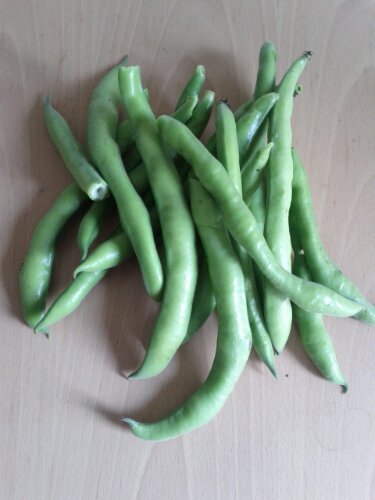
This week: the first harvest of broad beans from the garden. Two generous and insanely tasty portions eaten with baked sweet potatoes and baked tofu.

image

And a big bowl of fresh green leaves – the lettuces have really liked the damp weather. (I fear they may bolt soon now we’re having a heatwave.)

image

growing things

Protecting tomato seedlings

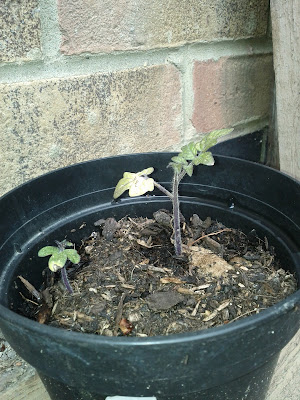
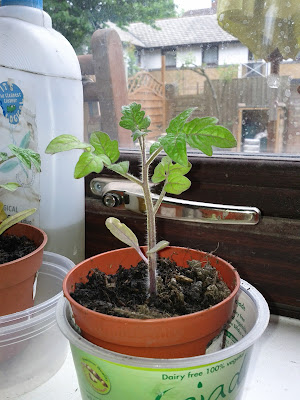
A quick photo to illustrate why it’s worth keeping tomato seedlings inside (or in a greenhouse) for that little bit longer, rather than just dumping them outside once they’ve grown their first couple of leaves and been transplanted. These are the same type of tomato and were sown at the same time:

Tomato seedling with 2 leaves, looking a bit yellow, in a pot outside
Transplanted and put straight outside

Tomato seedling with 4 leaves in small pot on windowsill
Transplanted and given another week on the windowsill

Not only does the indoor one have a healthier colour, it also has an extra pair of leaves. I’m hoping that the outdoor one will pick up in time but it’ll certainly take longer to reach fruiting stage.

I am considering a further experiment by picking one plant to put straight out from the windowsill without hardening off, and comparing that a week or so later with its hardened-off siblings.

Uncategorised

Allotment weeding with a baby

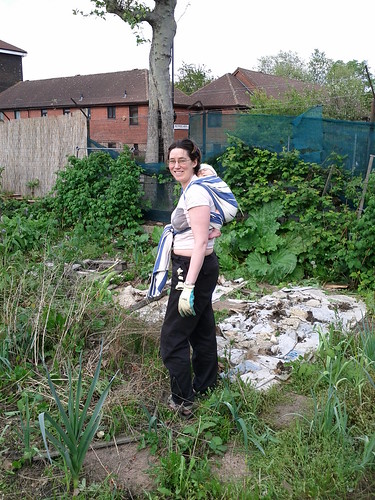
We already solved the problem of taking the baby to the allotment (and to lots of other places). This weekend for the first time I managed to get something done while I was there, too, rather than just telling doop what to do.

After a false start when Leon insisted that this was NO GOOD and he wanted MILK instead, I got him snugly up on my back & started clearing dead asparagus. Shortly after that I had sleepy baby breathing in my ear.

Untitled

With Leon in the allotment 1

All the potatoes are at last in, only a month late (although half of them did go in last month, and are already poking above the cardboard mulch). We have, from north to south (1.5kg of seed potatoes each set):

  • Orla (1st early, planted mid-April, to lift early July)
  • Lady Balfour (west of the apple tree) (maincrop, planted mid-April, to lift late August/early Sept)
  • Amorosa (1st early, planted mid-May, to lift early August)
  • Arran Victory (late maincrop, planted mid-May, to lift mid-Sept)

Not sure how well the Amorosa will do, given their late start, but if all goes well then we’ll have a nice spread of potatoes to harvest over the summer/autumn.

The final bed, in the south, will have butternut squash planted in it when the seedlings currently on the window-sill are a bit bigger. I should also think about a late summer catch-crop for the Orla bed.