Uncategorised

Making things: a place for things and a place for making

I have a couple of woodwork projects on my making-things list, but haven’t been making much progress with them. I realised the other day that part of the problem was the lack of space in the garage to start on a project, put it down, and come back to it later. Given that I expect to get interrupted about every hour or so when I’m at home (that’s roughly how often Leon feeds), I can’t necessarily finish a project same-day, and tidying away is daunting.

So before making places for things*, I made a place for making the things. I’ve done a bit of Freecycling and charity-shopping, moved some storage around, and now have a lovely space in the garage, near to the door for maximum natural light, where I can leave the workbench set up and a project stacked up on it.

I’m hoping to make a start on the toybox tomorrow as I think I have enough spare wood for that already. Really looking forward to it! I’m also hoping to get a bit of sewing done before I have to return M’s fabulous sewing machine on Tuesday. Now, it occurs to me that I could also do with a place to keep my own sewing machine… but perhaps best to stick to one thing at a time.

* My current projects are all storage-based: drawers for under my desk, a toybox for Leon, and perhaps a small set of shelves for Leon as well.

growing things, the garden project

Garden Diary 25.08.2012

Planted:

  • Basil.
  • Leaf coriander.

Harvested:

  • Courgettes.
  • Very tiny baby carrots.
  • Salad leaves.

Other:

  • Discovered that three of my blackcurrant bush cuttings may have taken!
  • Snails ate many of the chard seedlings; but it looks like one or two have survived.
  • Ordered some autumn/winter seeds.

To do:

  • Thin out lettuce some more.
  • Dig/set in border of long west bed properly.
  • Transplant courgette plants which I think are overcrowded.
Uncategorised

Garden diary 18.08.2012

In an attempt to keep better track of what happens in the garden, a new weekly note-to-self.

Planted:

  • 1.5 rows of turnips in SE bed.
  • 2 rows pak choi in SW bed.
  • 1 row chard in NE bed.
  • Handful of mustard greens in NW bed (I think… it was only yesterday and already struggling to remember!).
  • Mint cuttings and nasturtiums in box on front doorstep.
  • Nasturtiums in box by back door.
  • Strawberry runners into a little pot.

I made labels from takeaway cartons with permanent marker for all of these except the mustard greens.

Harvested:

  • Two courgettes.
  • Handful of chard.
  • Handful of salad leaves a couple of times.
  • Handful of baby carrots.

Other:

  • Moved tomatoes from polystyrene box to SE bed by fence, as they weren’t doing very well.
  • Pulled out a bunch of gone-to-seed rocket to make room for turnips and chard.
  • Misc weeding.
  • Moved chilli pepper from living-room windowsill to outside back door in hope that it will do a bit better.
  • Sorted out water butt / drainpipe diverter which wasn’t functioning at its best.

To do over next week:

  • Water plenty during the hot weather!
  • Thin out lettuce some more before it goes to seed.
  • Dig/set in border of long west bed properly.
Uncategorised

Farewell to the allotment

I knew that managing the allotment with a newborn this year would be a bit of a struggle. The plan was to mulch all the annual beds with cardboard, plant potatoes (fairly low-maintenance crop) through it, and hope for more time next year. Unfortunately, the dreadful weather was better suited to weeds than to potatoes, and we didn’t mulch quite thoroughly enough*. What with that, and the fact that I had even less time than I’d anticipated, when I finally made it back there a month ago it was a jungle.

That left me two options (given that my co-proprietor has no more time available than I do):
1. Put in a really big effort to get it under control again.
2. Give up, hand the keys over, and let it pass on to someone else.

On the way home, stressed and guilty, I began to plan for option one. Rip all the brambles out yet again, put a thicker layer of cardboard down over everything, paths and all. It seemed like the ‘correct’ thing to do. We’ve put a lot of effort into the allotment over the seven years that we’ve had it, and I didn’t want to let all of that down by failing to keep on trying.

And yet, and yet. The reality is that much though I have loved the allotment, in my current circumstances it has become more of a dread chore than a joy. Nor could I work out where the time would come from even to rescue it, still less to manage it properly for the next couple of years. And I do now have a garden (easier to find time for due to being right outside the back door rather than a 5 min bike ride away). When I asked myself which option would leave me feeling happier in a global sense, it wasn’t the one that involved a herculean effort just to stand still.

So last month, I harvested the last box of raspberries, left a map of the permanent crops for the new proprietor, and handed the keys back. I’m sad, of course. But it’s also a weight off my conscience and a relief to my already overloaded schedule to accept that at this time in my life, the allotment just doesn’t fit. I’m proud of myself for managing to make that decision without too much guilt.

I’ll miss it.

* What I learnt: mulch works best if you minimise the gaps (we had gaps around the edges of the beds) and mulch deeply. If I were doing it again, I’d mulch over the whole thing, paths and all, and with more layers of cardboard.

growing things, the garden project

Fitting a water butt

If you grow plants and have access to a gutter downpipe, it’s well worth finding the space and time for a water butt. Rainwater is better for your plants than tap water*; and of course you help conserve water as well.

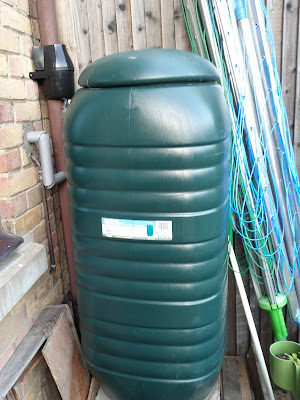
Water butt against fence

For small spaces you can get slimline water butts; we have room for a 250l one, and it’s worked out very well. This weekend was the first time this year I’ve needed to fill the watering can from the tap. I did put off fitting it for ages, but in fact it was an easier job than I had feared.

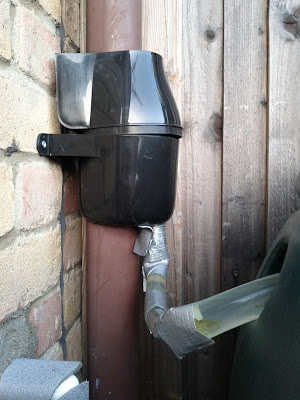
You’ll need a downpipe diverter, and a hacksaw to chop through the downpipe. The diverter kit will have detailed instructions, but basically you cut through the drainpipe at a height just below the top of the water butt. You then connect diverter and water butt with a piece of tubing, and when the water in the butt reaches the level of the drainpipe, the water will flow back into the drainpipe and down the drain. (Here’s a basic explanation of the physics of how water finds its own level; imagine the drainpipe, which is ‘bottomless’, as one of the tubes, and the water butt as the other, with the tubing connecting them.)

A note: when measuring the height of your water butt, it is VERY IMPORTANT to place the water butt high enough off the ground that you can get a watering can in under its tap. We used spare paving slabs; you can also get a purpose-built plastic stand.

Once you’ve cut the drainpipe and fitted the diverter and its tube, that’s it — you’re done, and your water butt is ready to collect water the next time it rains.

The only problem we’ve found so far is that the angle between drainpipe and water butt means that our tubing has a couple of kinks in it that tend to gather gunk & allow algae to grow. This means that it needs to be cleaned out occasionally to keep the water flowing. We’ve just added gaffer tape to reduce the amount of light and thus hopefully also the algae.

Drainpipe diverter and gaffer-taped tube to water butt

Next job: fitting a smaller one on the front balcony. I need to check this with the neighbours first, though, as we share that drainpipe.

* If you can’t use rainwater for watering, when possible it’s a good idea to let tap water sit for 24 hrs before using it on your plants, to allow the chlorine to offgas.

the garden project

The Garden Project: one year in

It’s now just over a year since we moved in to our new house and I started working on the garden.

Unfortunately I don’t have a photo of what it looked like when we moved in. However, the first things we did were to decide which side the grass would be and which side the raised beds would be. Here’s what it looked like after I’d put in the first raised bed and a couple of polystyrene containers, and we’d started taking up paving to put the grass in.

Before that, the whole thing was paving slabs or brick all over, so it was already looking much greener.

Once that experimental grass section proved successful, we got up the paving slabs and the surprise! concrete underneath (thanks to some very hard work from Pete and doop), and got the rest of the grass and wildflower seed down.

With the addition of the herbs and tomatoes in pots from our old balcony, it was looking quite good by October:

(Note also the compost heap at the bottom of the garden by the rose tree, built from the bricks we’d taken up from next to the fence.)

The winter-veg bed did well through the autumn. Over the winter, we put in an apple tree, some raspberries from the allotment, and I built another 3 raised beds from pallets.

I also finished a small shed, also from reconstructed pallets, in February while 38 wks pregnant. (This may have been a form of nesting; 600l of compost for the remaining raised beds also arrived two days before the baby did after a last-minute order.)

And over the spring I planted salad leaves, tomatoes, carrots, turnips, peas and beans, courgettes, more raspberries, rhubarb, and some flowers. In June, it was all doing rather well.

And a year on, it looks like this.

Not bad going, I think.

the garden project

The Garden Project: August update

Suddenly there is sunshine, after what felt like weeks and weeks of rain and grey skies. Here’s a quick roundup of things in the garden:

  • Fruit:
    • Two apples on the tree (I took a couple off when they first appeared, to reduce the load on the tree in its first year[0]).
    • A handful of raspberries, and the autumn raspberries flowering.
    • A handful of strawberries from three troughs.
    • Two rhubarb crowns transplanted from the allotment are doing well after wilting heavily at first.
  • Salad veg:
    • The bronze arrow-head lettuce has gone spectacularly to seed, with flower heads that are several feet tall. I’m hoping it’ll self-seed cleanly, but I’m not sure if there’s anything else around that crosses with it.
    • The rocket jungle, though extensive, is getting a bit too peppery as it too goes to seed. I may hoick some of the plants up as there really is a lot of it. It’s also self-seeded into the gaps between the paving slabs.
    • The misc lettuce still cropping happily in the salad bed.
  • Other veg:
    • The courgettes have started cropping and we’ve eaten the first couple.
    • The chard hasn’t really germinated terribly well. There are a couple of plants but I was hoping for more. Intending to replant for an autumn/winter crop.
    • No sign at all of the pak choi. Again, I’ll try replanting.
    • We had a reasonable crop of peas but those have gone now.
    • The tomatoes are growing away happily. The ones in the self-watering containers are doing noticeably better than the others.
    • The turnips doing well and we’ve already eaten the first row. Intending to plant another couple of rows for a late-summer crop.
    • There are plenty of carrots but they’re not growing all that fast. I’ve always struggled with carrots!
    • Very few beets germinated from the row I planted. Given the close relationship between beetroot and chard and the poor germination rates for both, I’m wondering if the conditions were just bad for these plants. (Alternatively, I may have had old seed as I’ve been using up seed from older packets.)

Things to plant in the next month:

  • Turnips.
  • Chard.
  • Pak choi.
  • Perhaps some winter cabbage or lettuce?
  • Rocket, except I won’t need to deliberately plant that as it’s happily planting itself.

[0] We bought it as a 3-yr-old tree; if it were actually a maiden I’d have removed all of the fruit in its first year.

Uncategorised

Trike review: 4.5 months in

Some time ago, before L was born, we bought a Christiania cargo trike, which we used for the first time when he was about 5 wks old. How is it working out now he’s nearing 5 months?

It has been absolutely invaluable for middling-local trips: to the shops (a mile away), the library (ditto), the breastfeeding drop-in cafe (1.5 mi). All of these are walkable distances but a mile is a long way to go when you’re carrying a baby plus books/shopping, and have dodgy knees. It also makes the whole thing quicker, and it’s fantastic for putting lots of shopping in.

It’s also been great for going to swimming classes (about 3 miles), but for now that’s about the furthest we can go.

The main issue is bumpy roads. Understandably, L does not like the bumps (the trike doesn’t have suspension, and while his car seat is padded, it must still be a bit surprising to bump around in it), and it turns out that the roads round here are fairly bad. We now take bumps very slowly, and as long as he’s in a good mood, he copes with them.

Regardless of the bumps, though, his tolerance is limited. It definitely pays to feed him before setting off, and if he’s grumpy to start with or it’s late in the day, we’re more likely to have problems. I have done several roadside feeds, and walked home, pushing the trike, with L in the sling, a couple of times. (I’ve also cycled at walking-pace halfway along the Thames Path with a grizzling L in the sling, when he refused point blank to go back in and I got desperate and achey, on the way back from the Royal Festival Hall. I wouldn’t recommend this, but I don’t think it was seriously unsafe given the speed I was going at.) Having said that, he’s also fallen asleep in it a couple of times, and if put into it when already asleep, stays asleep quite reliably.

He prefers to have the hood down (so he can see whoever’s riding it), which is fine when it’s not raining, and even if only raining a little if I cover his legs with a blanket. It gets pretty hot in there with the hood down, too, which he doesn’t like. As a result, we leave the hood down unless it’s proper tipping it down.

From the point of view of the adult rider: it is still not a speed machine! And it’s moderately hard work. I’d like to get a better saddle, too. You get considerable attention when riding it, but almost all of it has been positive.

If you’re considering getting one, bear in mind that you do have to carry the baby when you get out. Not a problem for us as we use slings rather than a pushchair anyway, but I doubt you could get a pushchair in there (certainly not a suitable for < 6 months one). General conclusion: awesome and well worth the money, but we haven't been able to use it quite as much as I hoped in the early months (I was faintly hoping to be able to do the 8 mi down to my parents' house, rather than taking the train, for example, and right now that's not feasible). I am, however, hoping that L will tolerate it for longer as he gets older -- he's certainly getting steadily less bothered by the bumping around already. On the upside, I have a good excuse not to cycle a 35-kg bike + 7kg baby + carseat + misc bits and bobs any further than 3 miles down the road, which is perhaps a good way of building those cycling muscles back up.

Uncategorised

Making a laptop caddy

In our household we have a tendency to leave laptops lying around the living room. It occurred to me, as L began rolling and trying really hard to crawl (he is currently managing whole millimetres at a time, often backwards), that this might not be a good long-term strategy.

So I consulted the rest of the household (the dog wasn’t that helpful), did some sketches, dug around in the piles of miscellaneous wood in the garage, and spent last Sunday afternoon making this between bouts of feeding L:

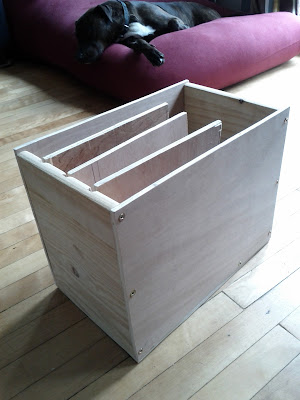
Wooden laptop holder with four upright slots

We have three laptops and a couple of tablets, so 4 slots seemed like plenty, with a box at the end for power cables. The original design was altered a bit when I established what wood I had readily available, but I think for the better (I was a bit too generous with the original sizing).

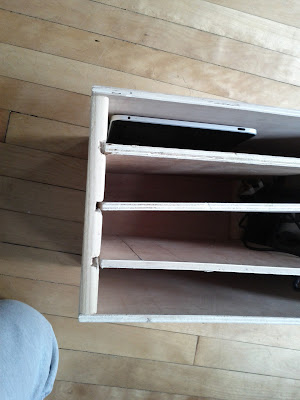
The short ends are a couple of bits of 3/4″ pine shelf offcut; the long sides and the dividers are plywood left over from a flooring project. The other ends of the dividers are held by a 1″ batten, because I didn’t have another piece of the 3/4″ pine:

Close-up of inside of laptop caddy, with wooden batten

To cut the slots for the dividers, really I could have done with a router[0], or failing that, a chisel which hadn’t been wrecked by being used to prise up carpet nails. I also realised afterwards that a hacksaw would have been a better tool than a regular saw. All in all, then, they’re not the neatest ever, but they do the job:

Close-up of top of laptop holder, with plywood sitting in roughly-cut slots in the end piece of wood

I’ll probably paint it sometime soon (we have some nice grey linseed wood paint left over from the same flooring project as the plywood) but the natural wood looks OK for now. And it’s doing the job, for the total investment of a dozen screws and an afternoon with the power tools and a manky chisel.

[0] After chatting to my Dad later, I will be getting a router next time I’m at B&Q. He says he’s spent 30 years repeatedly thinking that a router would be useful but not quite worth it for any given project…

the balcony project

Watering upstairs

We have some plants on the first floor; a few on the windowsills, and a few more now on the balcony (see The Balcony Project). We do not have any water on the first floor. So far, my watering has been at best intermittent (though given the recent weather this hardly matters for the balcony); what I’d like to do is to set something up to make it more reliable.

Currently, if I want to water the indoor plants, I have to pick up the small watering can, go downstairs and fill in, come back up and water. To water the balcony, I need to get the large watering can from the back garden, fill it, come back up, water, and take the watering can back down again.

The time when it would be easiest to water, and when I’m most likely to remember, is when L is playing on the floor; but I don’t want to be running up and down the stairs too much at that point. (Having said which – I could associate it with making myself a mug of tea.)

So; what might make this easier:
– having a watering can on the balcony?
– having a water container upstairs (perhaps on the desk) that I fill up on a more regular basis and then have available to water from?
– emptying half-glasses of water into one of these containers before clearing them downstairs?

So far that’s it on the ideas front & I’m not very convinced by anything there. Any other suggestions?