Uncategorised

How to deal with ants: pt 2

I posted before about eco-friendly ways to deal with ants in the garden. Today I dug up the small box of potatoes I was growing (harvest small but hopefully tasty!), to discover an ants’ nest, or at least a lot of ant eggs, in the bottom of the box.

This was especially irritating as I’d seen fewer ants around of late, and was hopeful that the cinnamon was doing the trick.

On this occasion, I did decide to try the boiling water, primarily aimed at getting rid of the eggs. As the potatoes were out of the box, it wasn’t going to destroy any plants; and despite my reluctance to kill them, I am really not up for hosting an ants’ nest on my 5m x 1.5m balcony.

After the boiling water (a kettle-full over the couple of buckets that the compost had been transferred into), I chucked a watering-can full of cold tap water in as well, in the hope of drowning or scaring away any remaining ants. Or at least convincing them to take their nest elsewhere.

Watch this space for results… [sigh] Unfortunately I think it’s going to be hard to get rid of them altogether, since I have a lot of plant-pots that I’m loathe to dig out altogether; so there’s always somewhere else for them to go.

activism

Tar sands activism today and next month!

I was up early this morning to walk the dog before heading off to smash the Piggy Pinata (link to photos) outside the International Banking Conference this morning. Video here. We handed out a big stack of Never Mind The Bankers newspapers, and copies of the booklet about RBS’ investment in the tar sands, to people going into the conference and to interested passers-by. The conference was looking at ‘reforming the banks’. What they mean is “how do we avoid the criticism (environmental and financial) whilst maintaining business as usual”. What we want is to stop investment into environmental disasters like the various tar sands projects and Deepwater Horizon — which are only the most obvious of the problems that fossil fuel investment causes.

Elsewhere, in the British Museum there was another BP sponsorship protest, with non-toxic ‘oil’ being poured around the Easter Island statue. This is after the Liberate Tate ‘oil’ spill at Tate Britain outside and inside the Tate Summer Party (celebrating BP’s sponsorship). (BBC report here.)

And, of course, Climate Camp 2010 is targetting RBS, the ‘oil and gas’ bank (currently investing in projects including tar sands) that is 84% owned by the public. Come up to Edinburgh in August to join in with the actions!

For more information, visit the Tar Sands In Focus blog or the No Tar Sands website.

Uncategorised

Small luxuries

Yesterday evening, whilst picking raspberries and blackcurrants at the allotment, I was thinking about small luxuries.

One of the things I appreciate most about the summer, these days, is the ability to eat raspberries by the handful. I’ve always loved raspberries — we had them in the garden when I was a kid — and for years I could get only the tiny, expensive, and often tasteless punnets that the supermarkets sell. Now there are twenty canes of them in the allotment (ten summer, ten autumn), and more raspberries than I can eat from June till September. A glorious luxury, with the only outlay (I think we’ve long since earnt back the £20 spent on the canes four years ago) the time it takes me to pick them, which is a pleasure in itself.

When I was cycle touring, eighteen months ago, my self-indulgence was that after the sun went down, I would light up the stove again to make a mug of tea, then crawl into my sleeping bag and lie there snugly in my tent with tea, a couple of chocolate biscuits, and an episode of Stargate (I have a fondness for dodgy SF TV) on the netbook. I remember thinking at the time that the only thing that could make the experience better would have been the ability to knit at the same time (the tent, sadly, was too small to sit up in, and knitting whilst lying on my stomach gave me cramp in my hands).

Since I’ve been home, one of my favourite small luxuries is to go to the library, then take my lovely new library books across the Blue to Adam’s Café, and read over a plate of chips and beans with a coffee. Costs around £3, feels fabulous.

It makes me immoderately happy, just to appreciating these little things.

Uncategorised

Solar ovens

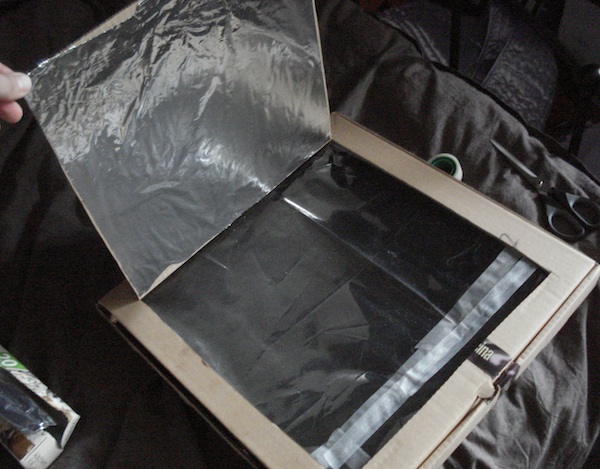
I made a pizza box solar oven at the weekend. I’ve been meaning to make a solar oven for a while, but this one struck my fancy because I had everything I needed already (including an old pizza box).

It turned out looking rather like this:

I used an A4 plastic document wallet (cut open and retaped to fit the hole I’d cut) for the film, and some black card (again, cut and retaped) for the bottom.

I tried it out with biscuits yesterday, and unfortunately wasn’t all that impressed. I’m not convinced that the box itself seals particularly well (so the hot air is escaping), and even allowing for half an hour to heat up, the biscuits were only halfway cooked an hour or so after I put them out. They did definitely warm up quite a lot; but not to anything like the temperatures suggested in the instructions linked above.

This may be to do with the UK climate, but my south-facing balcony catches the sun pretty well, so I’m loathe to give up entirely. Instead I intend to try this option, as soon as I’ve collected the necessary kit and have some free time.

growing things

Dealing with ants

We have ants on the balcony. We also have ants on the allotment (farming the aphids, mostly, which is both impressive and really, really annoying, leading as it does to the death of the broad beans). I have, therefore, been seeking ways to get rid of ants.

The executive summary seems to be: you can’t; learn to live with them. I have been trying this for some time, but the depredations are getting to be just a bit much. (Especially as they seem to have killed off the worms in the wormery as well.) So I’ve tried a few things.

I’m not prepared to do boiling water; plus it would take ages to boil enough with the storm kettle on the allotment, and on the balcony, it would kill whatever plant was in the relevant pot as well.

On the allotment, the best solution without a doubt has been ant nematodes. The compost heap was absolutely swarming with the damn things before I applied these, as was the paving by the pear tree; both are now clear. I also tried it on the balcony, but with less conclusive effect; the satsuma tree (which seemed to be the worst affected pot) looks to be mostly clear now, but they’ve just moved to the potato box.

Flooding out is one option (if they’ve built their nest in a pot where the plant won’t mind that). After emptying most of a watering-can into the potato box, I very soon saw lots of frantic ants carrying away eggs. But where to? I fear I may need to excavate the Area Under The Herb Table. I’ll repeat the treatment on the potatoes again shortly (and the potatoes should do well for it, as well).

Another suggestion I’ve seen a lot is cinnamon. So last night I went out and sprinkled cinnamon in copious quantities all over the balcony. Curiously, I couldn’t actually see as many ants anyway as I had before, so maybe the drenching has sent them off to find a nest somewhere that isn’t my balcony. I’ll report back on the cinnamon in a couple of weeks.

food, growing things

Germination and experimentation

I’ve had better success with carrot germination this year than in previous years, on both allotment and balcony. This might be due to very thick sowing; the rate is still poor, but the actual number is higher. Carrot seed doesn’t last from year to year, so you may as well sow the lot and thin if necessary, especially given the tendency to poor germination. Turnips and parsnips, on the other hand, have been worse than previously. According to the packet, turnips shouldn’t be planted in May (presumably due to pest problems?), but as we’re now into June, I planted another couple of rows this weekend, along with some more carrots and beets.

Another interesting suggestion in the book I mentioned in my last post is to reconsider advised planting times. The author mentions sowing French beans as a late summer catch-crop, sowing brassicas in June or July to avoid pest problems, and sowing carrots in June (advice which I’ve seen before elsewhere). What I’ve mostly taken from this is to experiment. Once the squash have gone out into the space reserved for them, I’m going to start planting other seeds into any spaces I have left, and see how they do. After all, the worst that happens is nothing, right? I should, though, probably keep slightly better records than I have tended to in the past.

Experiments started so far:

  • Late May carrots and beets.
  • Early June turnips, Brussels sprouts, and kale (some under protective hats, some not, mostly because I ran out of protective hats).

Experiments yet to be carried out:

  • June leeks.
  • June mange tout. (I have already planted some on the balcony.)

Last year I conducted some accidental experiments with tomatoes, as my tomato seedlings didn’t get out into their final pots until July. The result: fewer tomatoes, and most of them still green by October when I finally had to take them in. (I did get some very nice green tomato chutney, though). This year, the first seedlings were planted out in early May, and they’re already starting to flower. I’ve also found in the past through experimentation that tomatoes do much better in pots on my south-facing balcony than on the allotment, so the balcony is crammed with them and I’m looking forward to the first eating.

Experimental gardening does invariably involve a few failures, but at the least you wind up better informed about why the usual rules are what they are; and you may get surprisingly positive results. The usual rules are really just guidelines; it’s only practice (and experiment) that gives you information about your space.

Uncategorised

we are weeds, vegetation

Things I do not recommend doing if you are a gardener (or, in fact, even if you’re not, although it does get you out of doing any washing up for about two mnths): breaking your thumb. Despite this handicap, I have managed to be moderately productive on both allotment and balcony over the last month. You would think that weeding might be a one-handed activity, but it turns out that I use the other hand for balance more than I would previously have thought. Nevertheless, in the ongoing battle versus the weeds, I’m just about coming out on top. Two weeks off was more than enough to make it hard to catch back up; but when I did get going on the top bed (planted to roots this year), I found that carrot, beets, and one or two parsnips were making their way through the jungle. (What has happened to the rest of the parnsips? Who knows.)

I’ve also been reading a new book, “Organic Gardening the Natural No-Dig Way”, by Charles Dowding, and so far have come up with a couple of useful messages. The first concerns weeds: “a year of weeds is seven years of seeds”.

This has implications for green manure – if you don’t intend to dig in your manure (see ‘no-dig’), it will go to seed, making more trouble for you in the future. Dowding isn’t in favour of green manures unless (like mustard) they’re killed by frost before seeding.

It also has implications about the amount of work that needs to be done over the winter. This winter I did only very minimal weeding, as the weeds were growing only minimally, but in practice this just meant that I didn’t get on top of it before they went to seed in the spring. I’m definitely seeing the results.

I’ve been reminded during the intensive weeding process of the last couple of weeks of something I read from Bob Flowerdew: that it pays to keep going back to a bed you’ve weeded thoroughly before it obviously needs weeding again. Keep cutting off the tops of the weeds (if using a hoe) or uprooting them (if weeding by hand) and they’ll get weaker, so the job will become progressively easier.

I am constantly debating the issue of whether or not to bother keeping weeds that have gone to seed, and rhizome-type weeds, out of the compost. On the one hand, this is often recommended as otherwise your compost will just grow weeds. On the other hand, I’m never going to get rid of the weeds for ever anyway, and it seems a bit of a waste of compostable material. My current compromise is to leave the rhizome-rooted weeds out on the paths for a week or so to dry up before composting them.

This season I’ve also been thinking more about hoeing to speed up weeding. Making seed rows a hoe’s width apart helps, but the problem I’ve then encountered is that my rows aren’t always straight. With the next lot of planting (which will be the subject of my next post), I intend to actually use pieces of string, as I see the older gardeners on the allotment doing.

food

Rhubarb rhubarb rhubarb

It is once again the time of year when the rhubarb crowns go from “tiny new spring-announcing shoots” to “enormous rhubarb-triffids” pretty much overnight. Rhubarb crumble is good, as is rhubarb jam, but I thought I’d try something different this spring, and make rhubarb juice.

I used this recipe (summary: chop stalks into inch-ish chunks, cover with water, add a teaspoon of honey, boil for half an hr, then pour off the juice), and got 700ml of juice from maybe 10 decent-sized stalks. A teaspoon of honey was plenty (I might not bother with any at all another time).

The juice is nice neat; but even better with a little vodka, a couple of icecubes, and a sprig of mint. Very refreshing.

I turned the leftover pulp into rhubarb bread, using this vegan banana bread recipe. I estimated the volume of rhubarb pulp at about 2 bananas’ worth or a little more, so halved all the other quantities, and cut out the water as the rhubarb was pretty damp. Cooked for an hour at 180oC, it came out wonderfully. A bit like rhubarb crumble in cake form.

Next time I might try rhubarb liqueur.

Uncategorised

A most relaxing week

I spent an incredibly relaxing week over Easter at the Ecolodge in Old Leake, Lincs, with my partner doop and Sidney-the-dog.

The Ecolodge belongs to a lovely couple called Geri and Andy, who live in the house next door to it (the houses are sufficiently separate that you don’t see them unless you want to). It’s entirely offgrid: the electricity comes from a wind turbine and solar panels, there’s a compost loo, rain-water is collected for showering (although there is one tap in the kitchen which has mains drinking water), and heating and hot water are handled by a wood-stove in the main room. The stove is obviously usable for cooking as well – we did 90% of our cooking on it, but did use the little two-burner gas ring to boil the kettle.

One of the major attractions for us was the lack of ‘proper’ electricity. All the plugs in the place are 110V DC, so you need a special sort of plug for them, and you can’t just plug in your usual electrical kit. Which means no phones, no laptops, no iPod speakers… Instead, we read, knitted (in my case), did one of the jigsaws we found on the shelves, cooked, and chatted. A couple of times I switched the battery-operated radio onto Radio 3, but mostly I was happy just to listen to the birdsong and the subdued roar and crackle of the stove.

There’s a couple of acres of mixed woodland and meadow out the back, which Sidney particularly appreciated as it featured pheasants. If you are a 1-year-old lurcher cross who’s never been out of the city before, pheasants are, apparently, about the most fun it is possible to have. Happily she didn’t actually catch any, in large part because even the dopiest pheasant would have heard her coming from some distance away as she crashed merrily through the undergrowth. doop and I followed behind more sedately, watching the process of spring springing, with the trees bursting into leaf and the flowers starting to appear.

There are a couple of flattish local walks, or you can go a bit further afield if you’re not limited by having to take the dog along. We also spent an afternoon in the Art Stop, a slightly battered caravan equipped with pencils, crayons, paints, paper, and a box of fossils. I had enormous fun playing with colours like a 4-year-old. There’s also jigsaws (we completed a 500-piece one over around 6 hours and felt immensely proud), kids’ games, and a box of dominos (although neither of us could remember the rules).

Cooking on the wood stove is a slow process. It sometimes felt like our days revolved pleasantly around food (planning it and minding it), but the actual work involved was minimal. Just chuck another log or two on the stove every 45 minutes or thereabouts. We made one stew that was in the oven for over 24 hours (although not actually being cooked overnight), and it was sensational. Veggies were provided by the local organic farm, and there’s free-range eggs available locally as well. When we needed anything, doop set off on his bike to the Co-op in the village, 4 km away. Apparently cycling in this part of the world is a little bracing (read: windy).

I came back feeling incredibly relaxed and peaceful, and determined to spend more of my time not plugged into the internet. Indeed, I wrote this on my first no-wireless-at-home day on Wednesday (and have only just got around to posting it). Just switching off from everything was fantastic, and I felt so much better for slowing down. I may not be able to spend all day every day kicking back on the sofa while I’m back in London, but I do want to recreate some of that peace here. I’ll update with how it’s going after a month.

Uncategorised

Spring is sprung

And therefore it is time to start on the planting.

In the last couple of weeks on the allotment, I’ve planted chard, parsnips, peas, carrots, and beetroot. The overwintered peas and beans from the balcony have gone out to join the beans that overwintered in the allotment (the peas appear to have expired somewhere along the way). I’m not sure how well the beans are actually doing, but we’ll see. What I am sure of is that I should have planted many more of them to get anything like a crop. Ah well; a thing to remember for next year.

On the balcony, things are also getting moving. I’ve started my tomato, pepper, and chilli seedlings on the windowsill, and planted some carrots in a pot. The tomatoes appear a little reluctant to germinate; but I have 5 seedlings up and about now. (The chillis are known for taking ages to germinate and need it to be really warm.) Some of the overwintered peas have gone into balcony pots rather than to the allotment, and the cold-frames have been partway taken apart (they will be fully taken apart when there’s more storage room).

The sage and mint cuttings I made over the winter have both taken, and the mint is now growing furiously; the thyme (which died back a little over the winter) is reinvigorating itself; and the chives are back up again (always one of my favourite parts of spring).

Very excitingly, I had a look at the worms in the wormery yesterday and they have produced actual compost! They also looked a little sorry for themselves; I have added a little water (the balcony got quite warm in the recent sunshine, and I’ll need to bear that in mind over the summer) and some more food, so hopefully they’ll perk up.